Land Report #3: Winter Sand Gain, The Dune Toe, and When the Walk Disappears
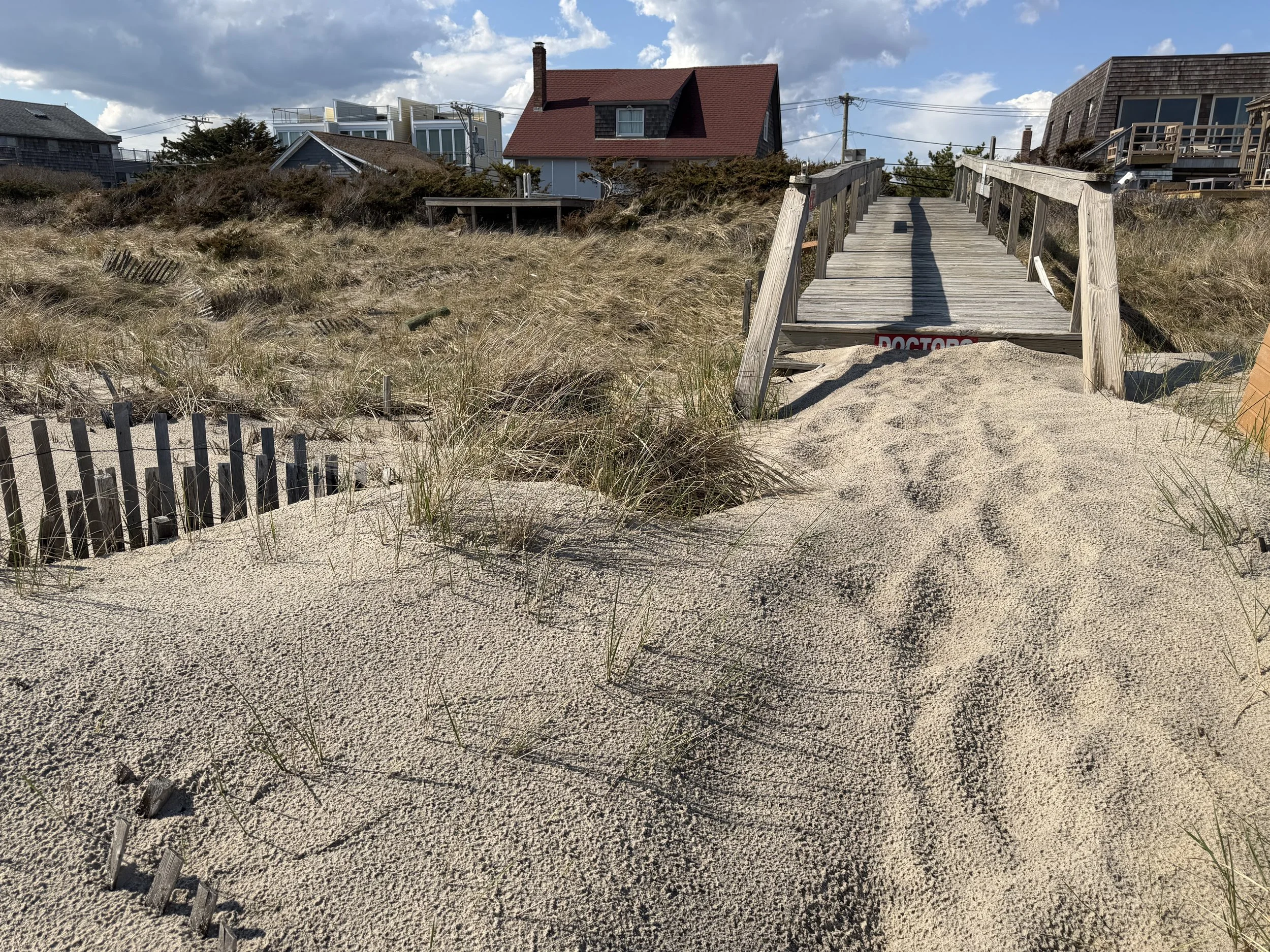
Spring of 2026
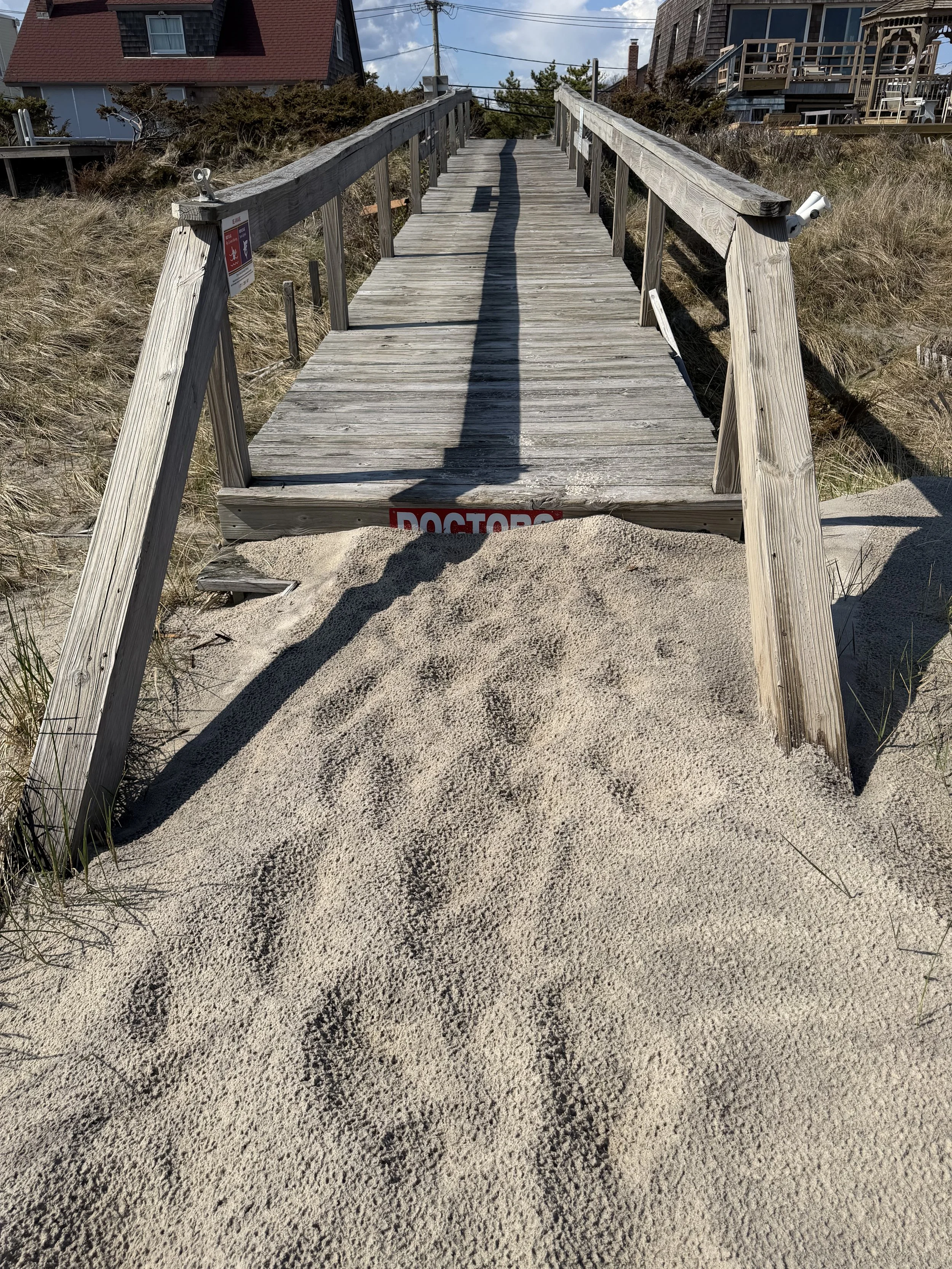
Wooden beach walk buried by winter sand accumulation, Fire Island
A buried walk is often read as a problem, access lost, something to clear, a failure of maintenance.
In most cases, it's the opposite. It's the dune advancing.
Wind-driven sand gathers at the toe, where it's meant to accumulate. This is the front line of the system, the place where energy is received, slowed, and stored. When sand collects here, the dune is gaining mass and increasing its ability to absorb future storms.
To remove that sand is to interrupt the process.
Reading the Moment
Whether to clear or leave the sand depends on one thing: where the dune sits within its cycle.
If the toe has pushed far seaward, into a position where waves will reach it multiple times a year, the strategy must shift. Do not build forward into that space.
Hard elements, posts, stairs, fixed walkways, placed too close to the active toe create turbulence during wave events. Water wraps around them, accelerates, and scours the sand. What results is not protection but erosion: a localized hydraulic disturbance that cuts into the dune where it should be building.
In these conditions, restraint is the correct response.
Keep structures landward of the active toe. Allow sand to accumulate without interference. Accept temporary loss of access as part of seasonal change.
For access, keep it minimal. Clear a step or two, just enough for even footing onto the sand, no different than stepping onto the beach itself.
When the Dune Resets
There is, however, a moment when the approach changes.
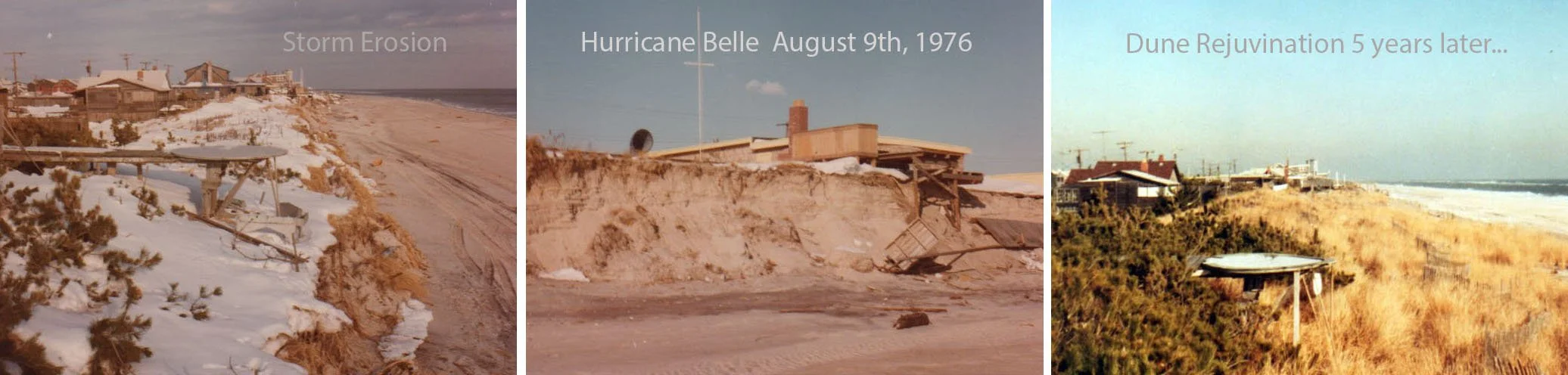
Steps removed in the storm of 1976 were later rebuilt forward, not immediately, but as the dune returned. They are not visible in this image, as the dune restored through the serpentine method, 1976–1981. Cherry Grove.
If structures have been held far enough back, and a major storm event cuts the dune, resetting the toe to a more landward and stable position, then access can be reconsidered. Only then.
At that point, the dune has returned to an earlier stage of its cycle. The energy line has shifted back, and space is available again for forward movement.
Steps or walkways may be advanced carefully into this recovered zone, but only with an understanding of where the dune will return to over time.
The limit is not convenience. It is the dune's known maximum reach, shaped by prevailing winds, seasonal sand transport, and the elevation of mean high water throughout the year.
Build beyond that line, and conflict begins again. Hold behind it, and the dune is allowed to move, build, and recover.
This boundary is not fixed. It is learned, observed over years, not assumed in a single season.
A Problem of Riches
When a walk is buried, it is often best left that way. The dune is stabilizing itself.
This is not a maintenance issue. It is a moment of gain, a problem of riches.
Clear a step or two for even footing onto the sand. No different than walking on the beach.
© 2026